


1. FOR HOW LONG HAVE YOU BEEN WORKING WITH HISTORICAL STYLE REEDS?
I started to read the Oziʼs book and inspired when I was studying in 2010, so ten years!
2. WHAT MOTIVATED YOU TO INVESTIGATE THE HISTORICAL REED MAKING
TECHNIQUE?
Mostly just personal curiosity, and when we call ourself historical instrument player or
call our activity historical informed performance I would like to try as much as what
those bassoon players did in the past. However I can see most of winds instrumentalists
use modern reeds and modern mouthpieces. I am curious what is the sound actually
when all the musician use original setting and I am waiting the moment to meet people
who play on original setting and have same idea.
3. FOR HOW LONG HAVE YOU BEEN HAVING YOUR REEDS SHOP?
2.5years
4. DID YOU START SELLING HISTORICAL REEDS FROM THE VERY BEGINNING?
No, I was hesitated to sell them, but after when I was getting confident about historical
reeds I started to sell them.
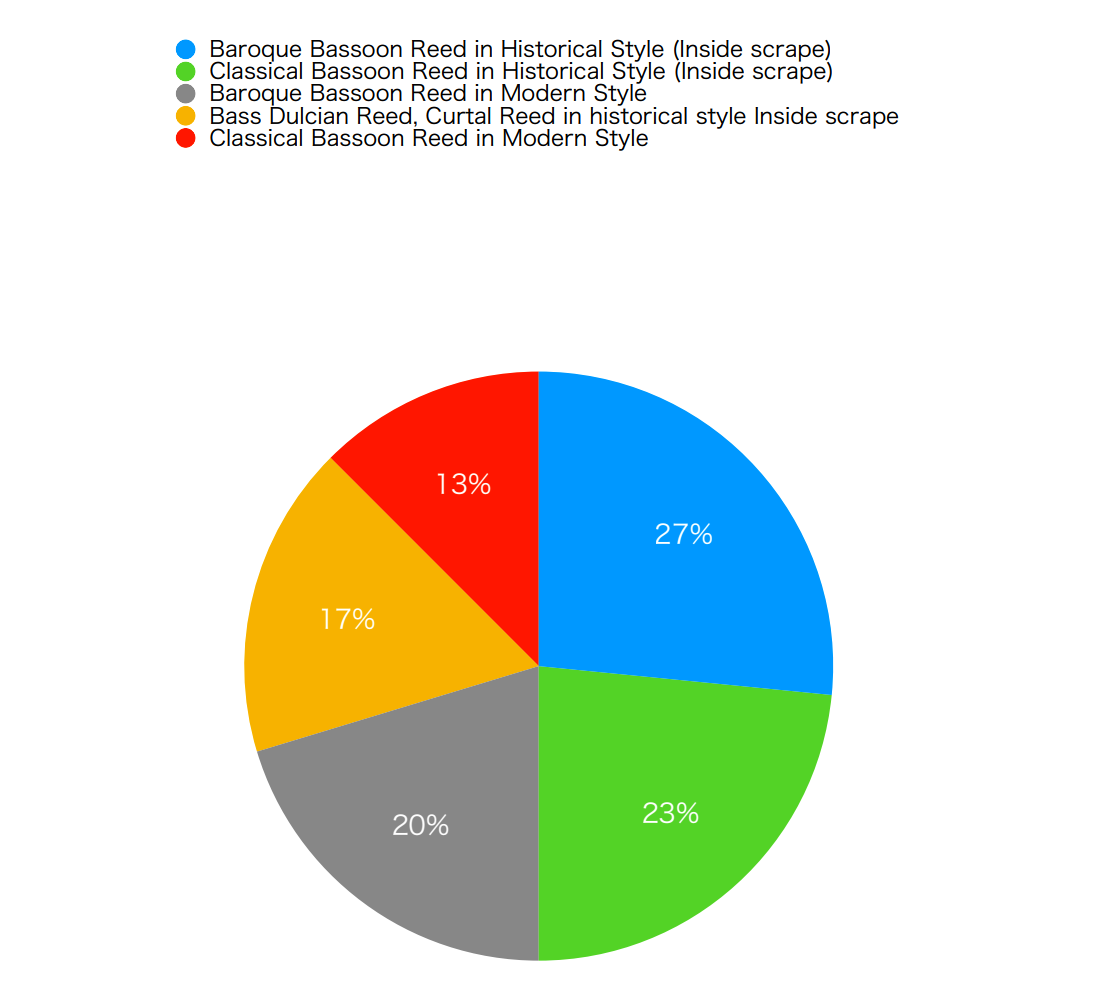
5. FROM YOUR BASSOON REEDS SALES WHAT IS THE PERCENTAGE OF HISTORICAL
REEDS VERSUS MODERN STYLE?
67% of sales are historical style in the category of historical bassoons which include
Dulcian, Baroque, Classical bassoon.
6. WHILE MAKING HISTORICAL AND MODERN STYLE REEDS; WHAT ARE THE
PERCENTAGE OF USEABLE REEDS WHICH YOU MAKE FROM THE HISTORICAL STYLE
AND THE MODERN STYLE?
My impression is that making modern reeds is much easier to achieve till the last
process. Perhaps itʼs because of making historical style reed requires using outside of
the cane where has more tension which gives more percentage of cracking. Letʼs say 7
to 10 percent of canes break during processes between gouging to tighten wire canes.
7. WHICH REEDS STYLE DO YOU PREFER TO PLAY ON THE BAROQUE BASSOON, A
HISTORICAL STYLE OR MODERN? CAN YOU EXPLAIN WHY?
Mostly I like playing on historical style reed, especially when I play basso continuo line.
There are mainly two reasons. First of all, the historical style reed give more vibration in
general which is not powerful or dominating the ensemble, but the vibration which can easily
circulate into the bassoon, this advantage bring benefit that is smooth transition
between note and note, and eventually this effect gives smoother playing and it will
match with other continuo instruments such as cello and it will create smooth musical
tide. Second reason is that the vibration of the historical reed has more consonance
which is very important for playing with other musicians when one speaks clearly others
can react or understand where the musician would like to bring the phrases, you can go
same direction with your agreement or otherwise you can start to discuss about the
direction. Additionally the sound with vibrations can associate with other instruments
more easily. With those reasons I prefer to use historical style reed.
8. IN YOUR OPINION, WHAT MAKES HISTORICAL STYLE REEDS DIFFER FROM MODERN
STYLE? WHAT ARE THE BENEFITS AND THE WEAKNESSES?
As I mentioned above the benefits is the vibration, I would also mention about the
weakness about historical style reed that is hard to find good balanced reed, especially
high resister. As it was very popular to have or to renovate previously made instruments
to late 16th century French bassoon which developed to ease playing high resister, on
the other hand it is not so common to play high resister in solo pieces with the
circumstance of German school baroque bassoon as you can find how German
composer wrote for bassoon.
When you choose the reed it is very rare to find a reed which has both feature the reed
plays high register and low register, it is depending on the reed and the caneʼs
character and the technique how to make the reeds. However multi-tasking reed need
good fortune of the cane mostly.
Combination of those matter can create painful sounds sometime. As J.S Bach
mentioned “nanny-goat bassoonist" one of his students. Poor boy, but he could make
better combination of instrument and reed, just he did not know there are options he
could choose. This is the weakness of historical style reeds when you make bad choice,
you will irritate others.
9. ON WHICH TREATISES ARE YOUR HISTORICAL STYLE REEDS BASED ON? ARE YOU
COMBINING SEVERAL METHODS? AND HAVE YOU MADE ANY OF YOUR OWN
ADJUSTMENTS WHICH YOU CAN SHARE WITH ME
In the beginning I followed Oziʼs method, and it was difficult to get reasonable result for
me, and I started look at the data from the IDR have given us few decades ago the title
is "Early Bassoon Reeds: A Survey of Some Important Examples" IDRS Journal 16
(1988). I tried to refer those numbers and assumed the thickness of inside scrape from
several examples. And I found the one, one of those reeds works with me and my
circumstance very well which is the one was together with Winnen Paris
bassoon(1822-1867) . This is obviously for classical period instrument and it is the best
seller item in my shop as historical style classical bassoon reed. And I apply this idea of
reeds for my historical baroque style bassoon reeds.
10. WHICH TOOLS ARE YOU USING FOR GOUGING AND SCRAPING IN YOUR HISTORICAL
STYLE REEDS? ARE THERE TOOLS WHICH YOU STOPPED USING SINCE YOU HAVE
FOUND BETTER SOLUTIONS?
”OLFA ROTARY CUTTER 28mm” I like using this tool very much to scrape the cane.
11. WHAT IS YOUR GOUGING STANDARD FOR HISTORICAL STYLE REEDS?
I use the cane thickness of 1.4mm and make up to 1.2mm in the middle of the cane,
but depending on the hardness, and flexibility of the cane, I slightly change the
thickness.
12. ARE THERE ANY ADDITIONAL REMARKS YOU WOULD LIKE TO ADD?
From my experience how much you gouge the cane is depending on the cane, each
makers cane has different thickness of outside skin, different fiber structure like some
has thin fibers, some has hard fibers etc, also some maker sales mixed canes from
several fields. Also, cane has sex like male female. You need to look at each cane and
need to give different processes respectively.
Leave a Reply